
Marlboro Directory Holdings
Verified holdings establish county-wide directory runs, not a complete Marlboro-only series. The strongest starting points are the historical microfilm listing, the New Jersey State Library holding list, and the local collections that can supply maps, yearbooks, newspapers, and context. A Marlboro entry may sit under a county, town, hamlet, or rural-post-office heading, so the table identifies collection scope as well as dates. Gaps between listed years are collection gaps. They do not establish that a family left Marlboro.
| Collection | Years | Where Held | Access |
|---|---|---|---|
| NJ Historical Society Monmouth County directory microfilm | 1885-86; 1891; 1897-1901; 1905-17; 1920-21 | Historical holding list, 10 reels | Inspect the reel and its town or hamlet heading |
| New Jersey State Library Monmouth holdings | 1875; 1898-99; 1904-05 | State Library holdings | Confirm the volume, publisher, and page before using it |
| Marlboro Branch local history | Directories and related material; full dates not posted | Marlboro Branch, 1 Library Court | Ask staff for the item and handling rules |
| Monmouth County Historical Room | County directories and local-history volumes; exact Marlboro runs not posted | Library headquarters, NJ Room | Non-circulating, secure-room research with a reference librarian |
| MCHA Research Library & Archives | County and city directories; exact run list not posted | 70 Court Street, Freehold | On-site archive and genealogy research |
The State Library list specifically identifies Boyd's Monmouth County Directory for 1898-99. That is a useful cross-check, not proof that every Marlboro household appears in that volume. County directories may favor businesses or settled places, and a reader should check spelling, initials, and the heading used in the book.
The dated holdings form a research timeline, not a continuous publication history.
- 1875: the State Library list identifies a Monmouth County directory.
- 1885-86 and 1891: the historical microfilm list identifies separate county runs.
- 1897-1901: county directories continue in the documented reel holdings; Boyd's supplies the 1898-99 lead.
- 1905-17 and 1920-21: later documented runs should be checked volume by volume for a Marlboro or hamlet heading.
Marlboro Directory Shelf Access
The Marlboro Branch of the Monmouth County Library is at 1 Library Court, Marlboro, NJ 07746-1184, and can be reached at 732-536-9406. Posted hours are Monday through Thursday from 9 to 8, Friday from 1 to 5, and Saturday from 9 to 5, with summer Saturdays listed as 9 to 1. The branch offers public internet computers, wireless access, scanning, printing, and copies. A local-history item may have separate access or handling conditions, so ask before assuming that a directory can be checked out or copied in full.
The Marlboro Library local-history collection documents directories alongside yearbooks, maps, photographs, church records, cemetery and Bible records, obituaries, and historical newspapers. Those companion sources can explain a name or place without turning one printed listing into a complete household account.
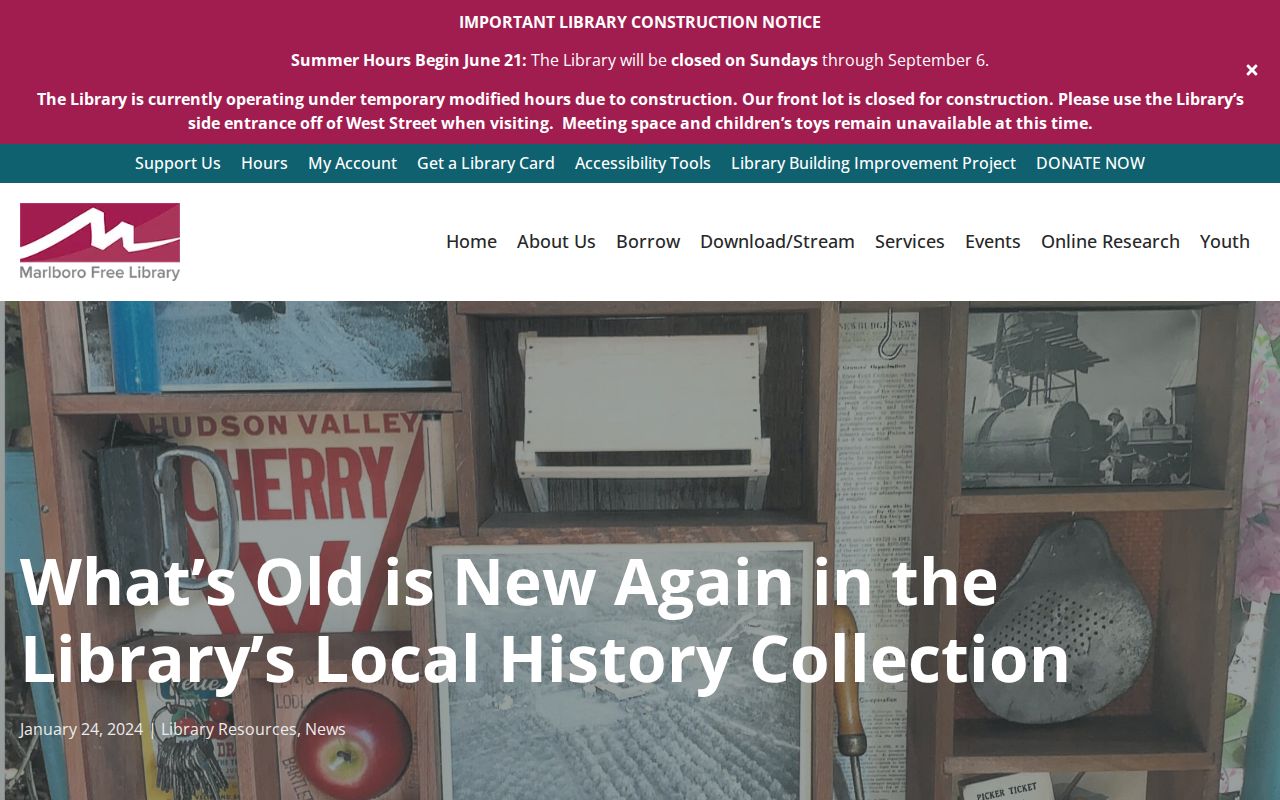
The local-history collection image shows the kind of repository lead that supports a city directory search, especially when a directory year, map, or newspaper item needs to be read in person.
Marlboro Directory Place Names
Marlboro became independent from Freehold on February 17, 1848, and its historical geography includes Morganville, Robertsville, Wickatunk, Bradevelt, and Topanemus. An older directory may use one of those place names or a rural post office rather than the modern municipality label. Search each reasonable name form, including Marlborough, before treating a failed surname search as an absence. The current road map is useful for modern orientation, but it does not prove that an old street number or postal label had the same meaning.
The township's early marl industry also surfaces in local artifacts and business-history leads. That local setting matters when a directory contains a farm, shop, or trade but little address detail. It gives a researcher another term to follow in newspapers or collection files, rather than a reason to infer a person's residence from an artifact alone.
Note: Record the printed town or hamlet heading with every result, because modern Marlboro labels cannot be projected backward onto older directory entries.
Reading Marlboro Directory Entries
No verified, public image-level Marlboro city directory page was available for inspection. For that reason, no sample name, address, abbreviation, or reverse-listing claim belongs here. At the reel or volume, use an inventory rather than a guessed transcription. It preserves the details needed to compare the entry with another source and makes the page, reel, and heading recoverable later.
| Name form | Record surname, given-name form, initials, and any firm or household cross-reference exactly as printed. |
|---|---|
| Address clue | Capture the street, rural post office, or hamlet wording, plus the volume and page or reel reference. |
| Occupation or business | Note it only if printed, then use it as a matching clue rather than proof of identity. |
| Household clue | Preserve any spouse, family, residence, or firm cross-reference only when the inspected page actually shows it. |
| Street index entry | Record it only if the volume has one. A normal surname listing is not a reverse-directory result. |
- Criss-cross directory
- An address-ordered or street-ordered section, when a particular volume actually includes one; it must be inspected before it is used.
- Householder index
- An index that identifies the listed household contact or head for that publication, not a full census of everyone at the address.
- Abbreviation key
- The volume's own explanation of shortened terms. Photograph or transcribe it with the entry instead of importing meanings from another directory.
Read the entry in the context of its page and heading. A similar surname in a different hamlet, a different year, or a business list may describe a different person. Page-level inspection is the check that turns a collection lead into a usable citation.
Marlboro Directory Research Limits
The official collection pages confirm county and city directories, but they do not publish a complete Marlboro-specific reverse-directory title and year inventory. They also do not establish annual coverage. A regular surname section should be searched by the printed name and place heading. If an actual volume offers a street index or criss-cross section, inspect it directly for an address-to-name entry. Otherwise, use the parcel, deed, or assessor record as the address anchor and return to the surname section.
Publication dates set the meaning of a listing. A directory can support an association with its stated address or business context at publication time. It does not by itself confirm title ownership, every member of a household, or presence during the years between volumes. Preserve the source location, call number when available, reel, page, and date with every note.
Marlboro Directory Cross-Checks
The Monmouth County Historical Association Research Library & Archives, at 70 Court Street in Freehold, adds obituaries, church material, cemetery transcriptions, estate material, tax ratables, and county directories. Its documented obituary runs include the Monmouth Inquirer from July 1830 to 1888, the Monmouth Democrat from July 1830 to December 1884, the Freehold Transcript from September 1888 to 1919, and the Red Bank Register from June 1878 to December 1988. These dated runs make useful time checks when a name appears or disappears from a directory.
The linked MCHA holdings page is the source for this archive image.
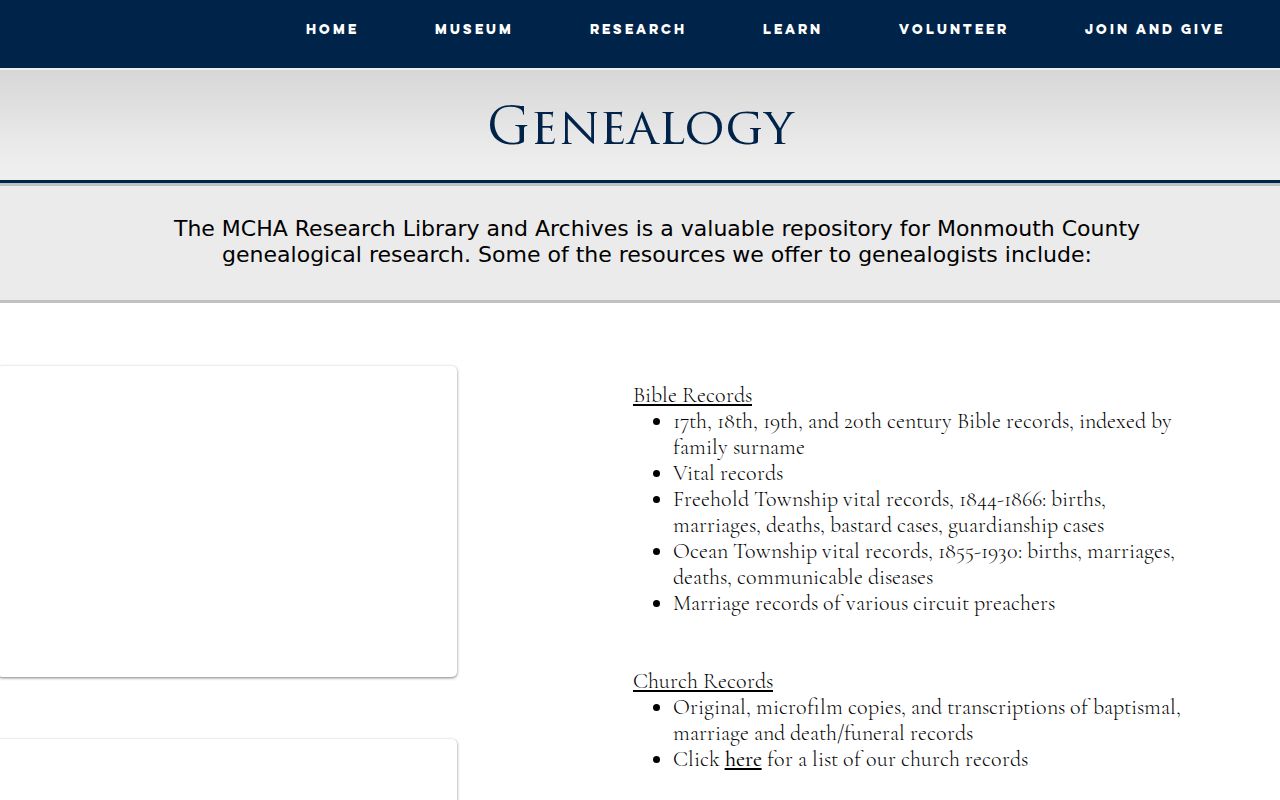
Use the archive's directory, obituary, church, and cemetery material as separate evidence streams, then compare dates and place labels instead of merging them into one claim.
Marlboro Local-History Artifacts
The branch's local-history article identifies Valley View Farm artifacts, Marlboro Bank construction drawings, and a Benmarl Winery lithograph among donations. These materials help frame a family, business, farm, or street in the local landscape. They are collection leads, however, not proof that a named person lived at a particular address. The Historic Commission archive also lists a 1977 Mercantile Establishments In Marlboro Township booklet that may supply a place or business term to pursue in the research room.
Pair that local context with the directory's date and printed heading. A name that fits the story still needs a page-level directory entry and an independent record before it is used for family history.
Tracing Marlboro Directory Households
Follow the actual published runs, not an imagined annual sequence. Start with an address, a name, or a hamlet already supported by a family paper, deed, or collection reference. The goal is to document a sequence of dated observations while leaving collection gaps visible. Census, deed, obituary, cemetery, church, and yearbook material answer different questions, so their dates should be kept beside the directory dates.
- Begin with the newest relevant Monmouth directory run and search the surname, initials, and Marlboro or hamlet label.
- Write down the exact printed entry, volume date, page or reel, and any street, rural-post-office, business, or family clue.
- Move backward through the documented runs. A gap from 1901 to 1905 is a holding gap, not a conclusion about a move.
- Compare the address clue with county deeds and historic tax material to keep occupant evidence separate from ownership evidence.
- Pair the directory date with the closest census and then use MCHA obituaries, church records, or cemetery transcriptions for life-event context.
- Use yearbooks, maps, photographs, and newspapers at the library to test a local connection, then cite each item separately.
For a current parcel or a full address-based record chain, use the Marlboro street directory. Historic city directories remain most useful for their printed, time-bound clues rather than for a modern parcel search.
Marlboro Directory Help Routes
When a shelf search is not enough, use the repository route that matches the record. The Marlboro Branch can help locate local-history material. The Monmouth County Historical Room holds more than 1,400 non-circulating books, magazines, directories, scrapbooks, and state, county, and local-history items in its secure NJ Room. MCHA supports archive and genealogy research. For older statewide and county material, the New Jersey State Archives provides a catalog gateway and genealogical collections, with mail and in-person research as alternate channels.
The New Jersey State Archives home page is the source for this archive access image.
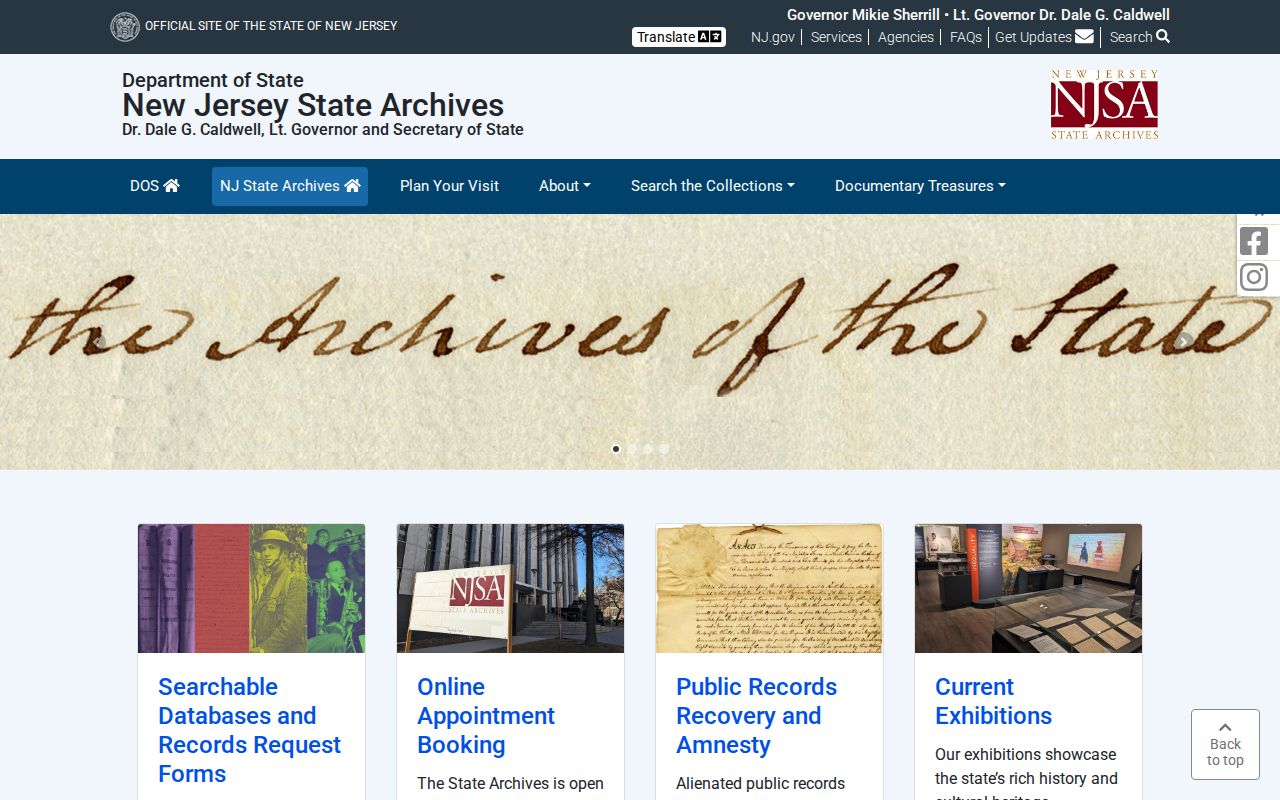
Archive and library staff can help identify a reel, volume, microfilm, or related record group, but page-level inspection remains necessary before a directory detail is quoted.
Note: A directory result is strongest when its volume, date, page or reel, printed place heading, and confirming source are recorded together.