
Marlboro Neighbors Block Sources
Public records can describe the parcels immediately around a Marlboro address, but each source has a tight boundary. A parcel map shows geography. Assessment and tax records describe a parcel and its assessed owner. The Clerk index records a transfer or other instrument. Voter and community sources have separate, limited access routes. For a block inquiry, start with the physical parcel and keep ownership, occupancy, participation, and historical association as separate facts.
| Source | What It Shows About a Block | Access |
|---|---|---|
| Monmouth County GIS | Parcel polygons, nearby roads, frontage, and map context | Browser map; current controls and layers should be checked live |
| OPRS property search | Current assessed owner, situs, block, lot, qualifier, and map context | Online search with county assessment-data contacts as a fallback |
| Tax Board portal | Year-specific parcel and tax-list context for the same block and lot | Online portal with township, year, owner, and block/lot modes |
| County Clerk OPRS | Recorded transfers and named parties connected to an instrument | Online index, Clerk counter, and archive routes for older material |
| Voter channels | Individual status or a lawfully requested election-district list | State status portal and Commissioner of Registration request route |
| Community sources | Participation or contact paths, not a block roster | Township and association pages with nonpublic membership limits |
An assessed owner is not automatically the person at the situs address. A parcel can be held by a trust, estate, or entity, and a person may appear in a deed as a party without living on the block. The next steps should test the parcel and document relationship, not convert a name result into a household claim.
Map Marlboro Neighbors by Parcel
The block method moves outward one parcel at a time. First identify the target parcel and preserve its block, lot, and qualifier. Then repeat the property and tax searches for the immediately adjacent parcels. The Clerk index can add a dated transfer trail where it is relevant. This keeps the work tied to a physical block, unlike a broad surname search that may mix unrelated people.
- Open the OPRS property search and select Marlboro Township. Search by the target’s street name or a short street fragment, then confirm the address.
- Record the target parcel’s situs, block, lot, and qualifier. In the county map context, zoom to the parcel and identify the surrounding polygon boundaries and road names.
- Write down the block and lot identifiers for only the parcels that directly touch or face the target, depending on the question being researched.
- Repeat OPRS for each adjacent block and lot, then compare the same parcel in the Tax Board portal for the selected year.
- Use the Clerk index by block and lot or party name for a recorded transfer question. Compare the instrument, date, legal description, and party role before connecting it to the parcel.
- Township Name
- The required OPRS municipality selector. Choose Marlboro Township for a local parcel search.
- Address
- The OPRS address mode accepts a street name or part of a street name, rather than requiring a full address string.
- Block and lot
- Parcel identifiers used to repeat the same search across OPRS, the Tax Board portal, and Clerk records.
- Qualifier
- An optional identifier for a condominium or another qualified parcel.
- Owner Name
- An OPRS current-owner search field, useful only after the parcel relationship is confirmed.
For a longer named-street history, use the Marlboro street directory, which follows the separate street-by-street record chain.
Marlboro GIS Interface Gap
The County GIS viewer is the map layer for parcel adjacency, road frontage, easements, and parcel shape. Research documentation supports the general browse-and-identify method: zoom to the area, select a parcel or map location, and open available property details. The live ArcGIS interface was unavailable to the text-only inspection, however, so exact current button labels, layer names, and any radius choices should be verified in a browser before relying on them.
That gap matters. A polygon can establish that parcels are next to one another, but it is not a directory of Marlboro neighbors. Use the GIS view to collect block-and-lot context, then use OPRS for text-based assessment information and the Clerk for the legal record.
Marlboro Neighbors Tax Comparison
After identifying adjacent block and lot numbers, the Tax Board portal provides a same-year comparison point. Its address mode uses a street name and Township, and its owner mode can use an owner name with an optional Tax Exempt filter. The portal also has a block-and-lot mode and aggregate criteria. Preserve the year selected, because a tax-list result is year-specific rather than an all-time description of the parcel.
| Tax Board field | Use for an adjacent-parcel check | Limit |
|---|---|---|
| Township and Year | Sets Marlboro and the particular tax-list year. | Available years are controlled by the portal. |
| Street name | Finds parcels along a named street in address mode. | It does not establish every person associated with a parcel. |
| Owner name | Offers an owner-mode cross-check. | An owner may be an entity, trust, or non-situs correspondent. |
| Block, lot, qualifier | Matches the exact parcel across county systems. | Use the legal document for a recorded transfer question. |
Property class, exemption, and other tax codes help interpret a parcel’s assessment context. They are not evidence that a named person lives there. The situs and mailing-address distinction remains important at every block comparison.
Marlboro Neighbor Addresses Differ
The situs address is the physical location of a parcel. An owner mailing address is the place used for assessment or tax correspondence. They can differ when an owner is elsewhere, uses a business or agent address, owns through a trust or entity, or holds a parcel that is not a home. A mailing address from another town or ZIP must not be mapped as the owner’s residence.
Likewise, someone connected with a block may be present at the situs without appearing as an owner. The cleanest neighbor record is therefore modest: identify the adjacent parcel, the record date, the current assessed owner where shown, and any separate deed or tax fact. Do not make a claim about a person’s presence from a correspondence address.
Note: Parcel ownership and a person’s present address are separate facts that need separate evidence.
Marlboro Neighbor Voter Boundaries
The New Jersey Voter Search is intended for individual current-status inquiries. The state directs searchers to use the county’s spelling of the name, and the text-only research could not confirm the live form’s present labels. It is not a public street-by-street layer. Inactive status, a spelling difference, or no result does not prove that a person never lived at a nearby address.
The legally relevant block-level route is different. Under N.J.S.A. 19:31-39, a voter may request an electronic or computer-generated list of registered voters in one or more election districts from the Commissioner of Registration. The uniform reproduction cost is capped at $375. Signatures are excluded, and home addresses approved for nondisclosure are excluded. A voting-district map can provide a geographic cross-check, but a polling place is not evidence that a particular person lives nearby.
Marlboro Community Sources Are Not Rosters
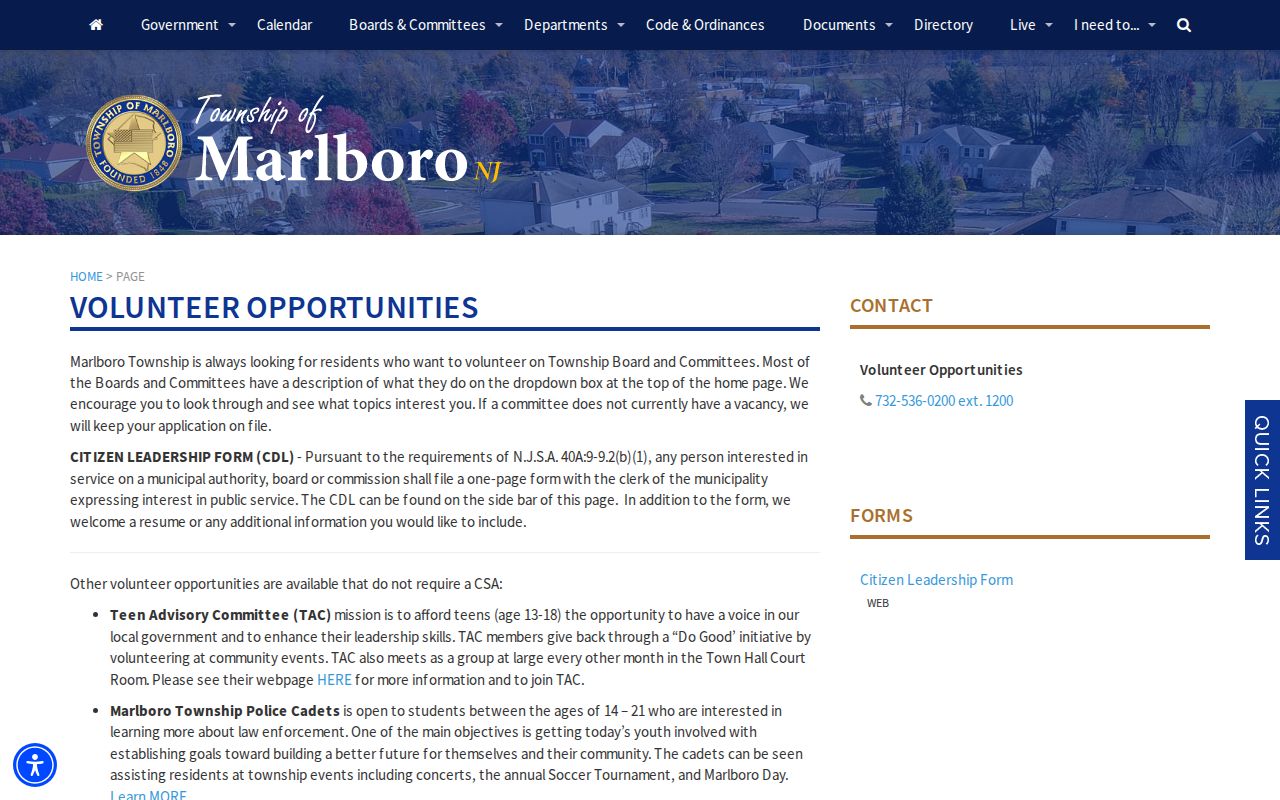
Marlboro’s volunteer opportunities page provides ways to participate in civic boards, committees, youth advisory activity, public-safety volunteering, and other local efforts. It is useful for community context and contact routes, not for identifying people on a block. Participation in an event, meeting, or program does not establish a home address unless an official record expressly supports that fact.
The official volunteer page illustrates the participation-only layer of a Marlboro neighbors search.
The Marlboro Municipal Alliance, established in 1990, meets during the school year and includes several local sectors, but no public roster was found. Recreation registration uses CommunityPass, and participant lists are not publicly posted. These intentional limits protect personal information and should not be worked around.
Marlboro Association Directory Limits
No official township-wide neighborhood-association directory or resident roster was located. The available sources are useful for knowing whether a community route exists, not for assembling names. Kensington Gate HOA is a local example that identifies its community and contact route without publishing a member directory. It is a non-governmental association, so its internal member information is not a public township record.
Kensington Gate HOA
Public-facing community association for Dutch Lane, Marlboro, NJ 07746. Its site directs residents to board or management contacts and does not publish a public member directory.
Marlboro Municipal Alliance
Township community program established in 1990. Its official information describes participation and meetings, not a named roster.
Marlboro Recreation
Official recreation information routes registration through CommunityPass. Enrollment details are not a public directory.
Marlboro Neighbor Tools Compared
Official records and commercial neighbor tools serve different purposes. Official sources identify their custodian, date, and record type, making it possible to check the underlying parcel or document. Commercial tools may combine old address signals and other data into a convenient display, but a combined display cannot replace a dated county record or establish that someone currently lives on a Marlboro block.
| Source type | Useful question | Boundary |
|---|---|---|
| Official parcel and tax records | Which parcel is next to the target and who is the current assessed owner? | They do not establish every occupant. |
| Recorded-document index | What dated transfer or instrument links a party to the parcel? | Party role and legal description must be read; online results are informational. |
| Voter and community channels | What limited status, district, or participation route exists? | They are not a household roster and have statutory or nonpublic limits. |
| Commercial neighbor tools | What leads might need independent checking? | They can be stale, incomplete, or mismatched and should not replace the custodian record. |
Use a commercial result, if encountered, only as a prompt to check an official custodian. Do not try to fill protected fields or missing addresses from another source.
Marlboro Neighbor Privacy Boundaries
New Jersey programs deliberately leave gaps in public data. The Address Confidentiality Program gives eligible participants a substitute address for government use, and Daniel’s Law redacts home addresses for covered people on government websites. The Office of Information Privacy reported more than 10,000 protected people as of April 28, 2025. A redacted or blank field is a privacy control, not a puzzle to solve.
Keep sensitive information out of a block inquiry. Court and vital rules, OPRA exemptions, and motor-vehicle privacy rules all protect different kinds of personal data. Request a specific, releasable county or municipal record from the correct custodian when necessary, and accept redactions and nonpublic association limits.
Lawful use. Use Marlboro neighbors records for a legitimate personal, civic, or historical purpose. Do not stalk, harass, intimidate, expose a protected address, or attempt to bypass a privacy safeguard.