
Marlboro Previous Residents by Era
Previous residents of a Marlboro address appear through different records in different periods. Begin with the era, then choose the repository that preserved the right kind of evidence. A deed can place a party in a transfer. A directory, census, obituary, or local collection can supply a household clue. They are not interchangeable.
| Source | Years It Covers | Where Held | What It Shows |
|---|---|---|---|
| County conveyances, deeds, estates, church and cemetery records | Colonial–1847 | County sources, MCHA, and archives | Land transfer, kin, burial, and related local evidence |
| Deeds, county books, directories, and census | 1848–1874 | County and State Archives routes | Ownership, occupation, and early household context |
| Monmouth directories, census, obituaries, and marriage/death databases | 1875–1900 | Library, MCHA, and State Archives | Name, address, occupation, and family clues |
| Directory runs, deeds, newspapers, and census | 1901–1921 | Local-history and archive repositories | Address trail and transfer history |
| Library history, newspapers, deeds, and vital-record routes | 1922–1969 | Library, MCHA, State/local custodians | Household leads, legal transfers, and local context |
| OPRS deed, tax, property, GIS, and municipal OPRA records | 1970–present | County portal, Clerk, Township, and archives | Strong current parcel anchor, subject to redactions |
For a modern address, start with OPRS property data and the latest recorded document. For an older address, the State Archives, FamilySearch, MCHA, county library, and Clerk archives may be the first practical route. The online record does not run without a break from the colonial period to today.
Note: Start with the source closest to the target year, then use another record type to test the connection.
Marlboro Previous Residents Start Here
Anchor a prior-residents search to the current situs address and parcel first. The Monmouth OPRS property search can supply a current parcel context, then the block, lot, qualifier, owner, and any displayed mailing distinction can be carried into the Clerk index. Write down the exact situs rather than assuming a mailing address marks the physical property.
Marlboro’s Historic Commission archives offer local publications that can add context after the parcel is known.
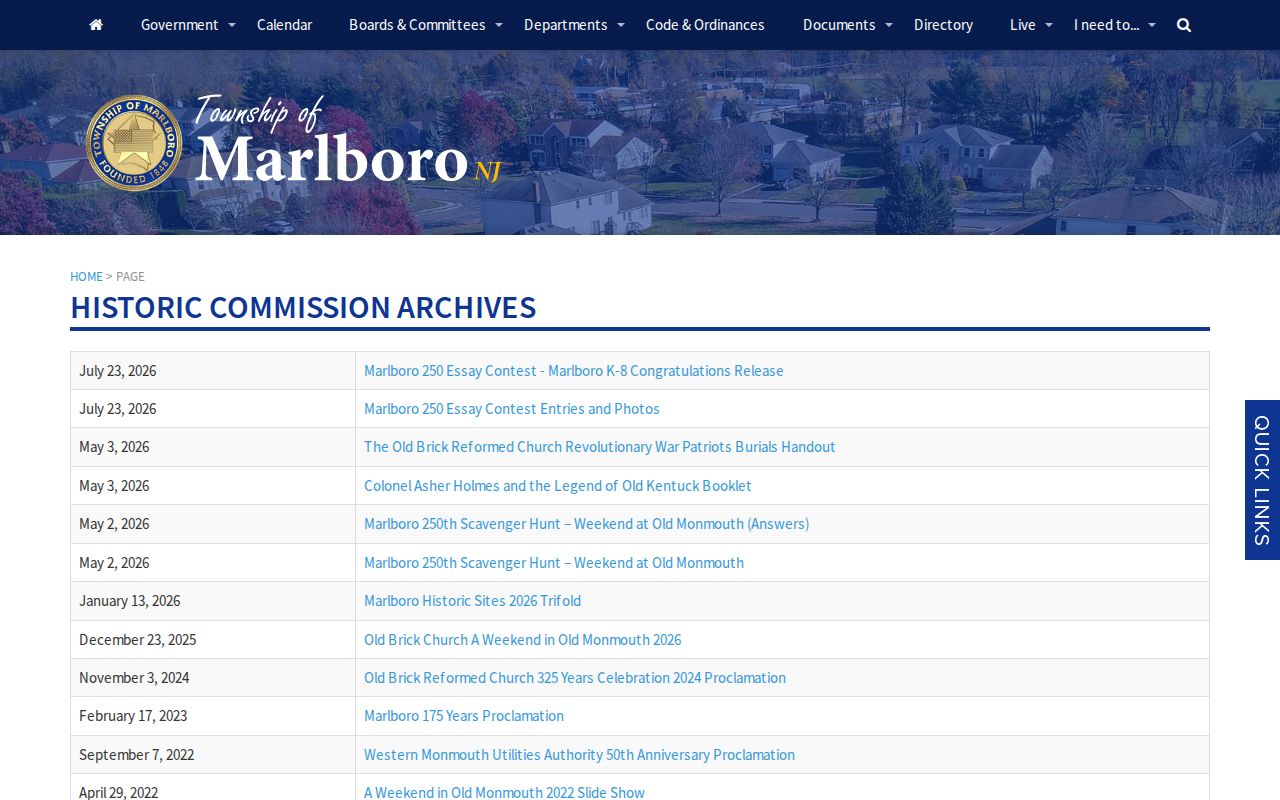
The archive listing includes a 1977 booklet, Mercantile Establishments In Marlboro Township, and a May 1969 building code. These are collection leads. They do not prove that a named person occupied a modern address without matching parcel and dated-record evidence.
Trace Marlboro Previous Residents Through Deeds
The deed chain follows legal title, not a full occupancy history. Start with the current parcel result and newest deed in the Monmouth County Clerk’s OPRS index. Search first by block and lot or the present owner. Then read the grantee and grantor roles, recording date, instrument or book/page, and legal description before moving to the earlier transfer.
- Record the current situs, block, lot, qualifier, and legal-description clues from OPRS property data.
- Find the latest purchase deed through the Clerk index and identify the buyer and seller as recorded.
- Search the prior seller as a grantee to find that party’s earlier purchase, then compare the legal description.
- Repeat the process one transfer at a time. Flag a split lot, combined tract, trust, estate, or entity instead of forcing an address match.
- Move to the Clerk counter, archive, or older deed resources when the online coverage stops. Preserve book, page, repository, and record date.
- Grantor
- The party conveying an interest in a recorded document.
- Grantee
- The party receiving that interest. A grantee is not automatically a resident at the parcel.
- Chain of title
- The sequence of recorded transfers for a parcel or tract, checked from one instrument to the prior one.
- Legal description
- The land description used in a record, often more durable than a street number when a tract changed or an address was not used.
Note: A sound deed chain states each recorded party and transfer without claiming that all owners lived at the property.
Marlboro Previous Resident Deed Cutoffs
OPRS does not have one universal historic start date. The county lists deeds from January 1, 1970; mortgages from January 1, 1976; other published records from October 1, 1996; and IRS liens, withdrawals, and releases from January 1, 2010. Treat the category cutoff as controlling. An online gap can reflect the portal’s coverage rather than a gap in legal title.
The Clerk’s OPRS modes include instrument number, document type, block and lot, and name. Document-type and block-and-lot searches use date ranges, with a stated maximum 90-day online interval. Narrow the request rather than assuming a townwide or all-era export.
Marlboro Previous Residents Beyond OPRS
Older Monmouth records require a deliberate repository chain. The New Jersey State Archives describes county deed microfilm through 1900, Monmouth deed books before 1785, and county mortgage coverage through 1850. It also says county deeds have been digitized by FamilySearch, although the available search and viewing path can vary. Use the County Clerk counter for title-quality work, then compare State Archives, FamilySearch, MCHA, and library holdings for the earlier trail. The Archives’ access route includes online databases, mail research, in-person microfilm, and its catalog gateway. MCHA and the County Historical Room are on-site research alternatives when a collection is not online.
The Monmouth County Clerk estate-record archive provides a related historical record route.
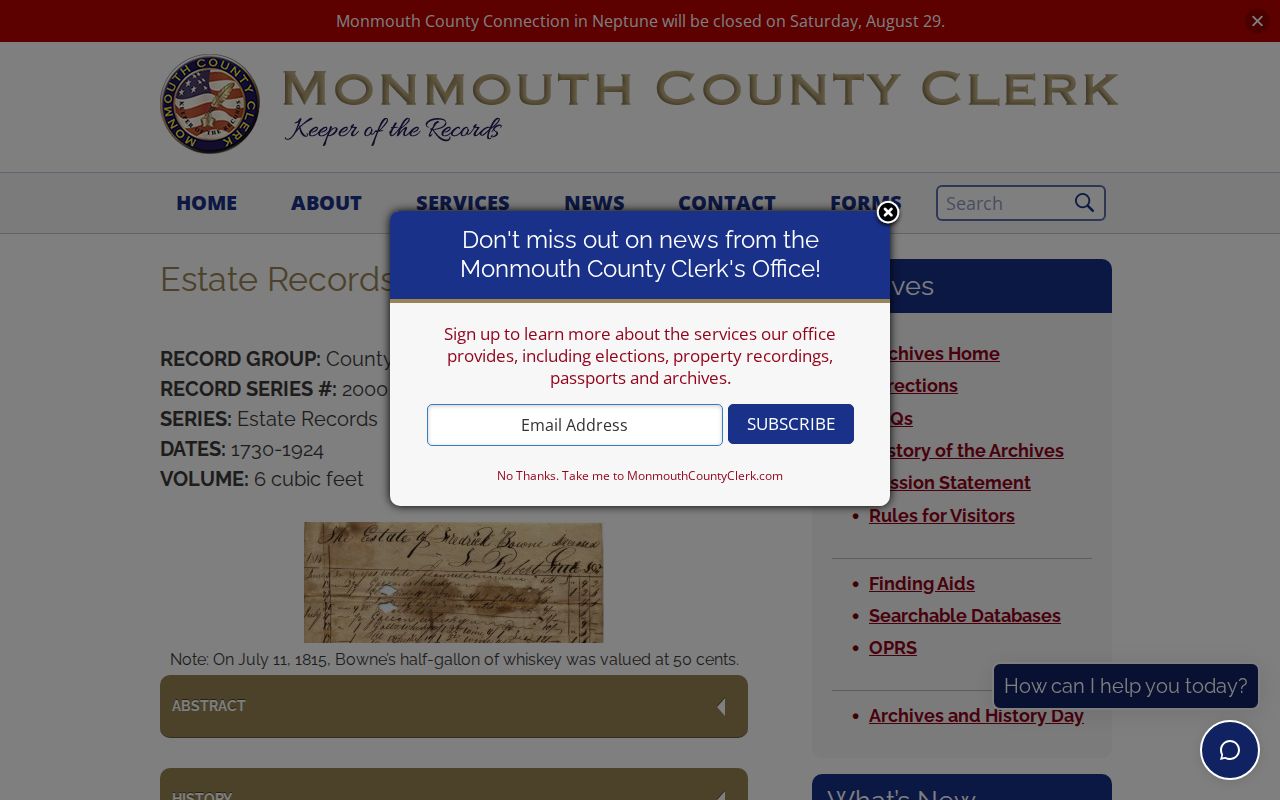
Estate and surrogate material can clarify kinship or a transfer context, but it should be read as its own record group and not used to assume a person lived at a particular address.
Note: Archive access and digitized availability vary by record group, so record the repository and accession details.
Marlboro Directory and Census Pairing
The household layer begins after the deed chain is anchored. Monmouth directory holdings include runs for 1875, 1885–86, 1891, 1897–1901, 1905–17, and 1920–21. The official holdings do not establish annual, Marlboro-only coverage or a complete reverse-directory title list. Search a surname, address, and hamlet label in the actual volume, then retain the volume, page, reel, and date.
- Place the deed transfer and its legal parcel in a time band.
- Check the nearest available directory run for the surname, street, rural address, or historic locality.
- Pair that entry with the relevant New Jersey or federal census window, tax ratable, obituary, church, or cemetery clue.
- Compare the geographic label and household relationships before treating the records as the same family.
- Record gaps honestly. A missing annual directory is a collection gap, not proof that a household left.
The collection details belong with Marlboro city directories; the address history uses those volumes as dated household evidence rather than trying to rebuild their catalog here.
Marlboro Previous Resident Place Names
Marlboro became independent from Freehold on February 17, 1848. Earlier research can therefore require Freehold-era and county sources. The township developed around Morganville, Robertsville, Wickatunk, Bradevelt, and Topanemus, and an old directory or obituary may use one of those labels instead of Marlboro. Preserve each spelling in the research notes.
Modern postal labels and street names cannot be carried backward automatically. The official road map is useful for current orientation, but it is not a historical number-conversion record. No official Marlboro street-renumbering timeline was verified, so compare dated maps, legal descriptions, and the original directory page rather than creating a conversion.
Marlboro Record Gaps After Fires
Monmouth County history reports courthouse fires in 1855 and 1873, with most vital records saved. A later 1930 fire affected the courthouse stair and belfry, and county functions moved to Court Street in 1954. That history explains why a prior-residents search may lead from the Clerk to MCHA, the library, County Clerk archives, and State Archives.
Most vital records saved does not mean every deed, estate, marriage, or municipal paper survived or was indexed alike. Record the repository and record group with every result. Absence from a modern index is not proof that the historical record never existed.
Marlboro Previous Resident Permit Records
A permit can date construction, an addition, or an administrative approval. It does not prove who occupied a property. Marlboro Zoning and Code Enforcement maintains block-and-lot files for permits, plot plans, surveys, approvals, and resolutions, while the SDL portal is for current application submission rather than a public history database.
For an offline file, send a written request through Marlboro’s OPRA route or contact the zoning office with the address, block/lot, file type, and a bounded period. The municipal form allows hand delivery, mail, fax, email, or online submission. A request seeks an existing record; it cannot require the custodian to research or create an answer.
Marlboro Previous Residents Sanborn Gap
The Library of Congress Sanborn Navigator is a useful map-research tool, but no Marlboro-specific Sanborn atlas sheet or year was verified in the source review. Sanborn mapping is more likely for incorporated or dense places than for a rural township-wide parcel inventory. Do not imply that it offers a Marlboro house-history result.
The Library of Congress Sanborn Navigator is shown here as the broader map-research resource.
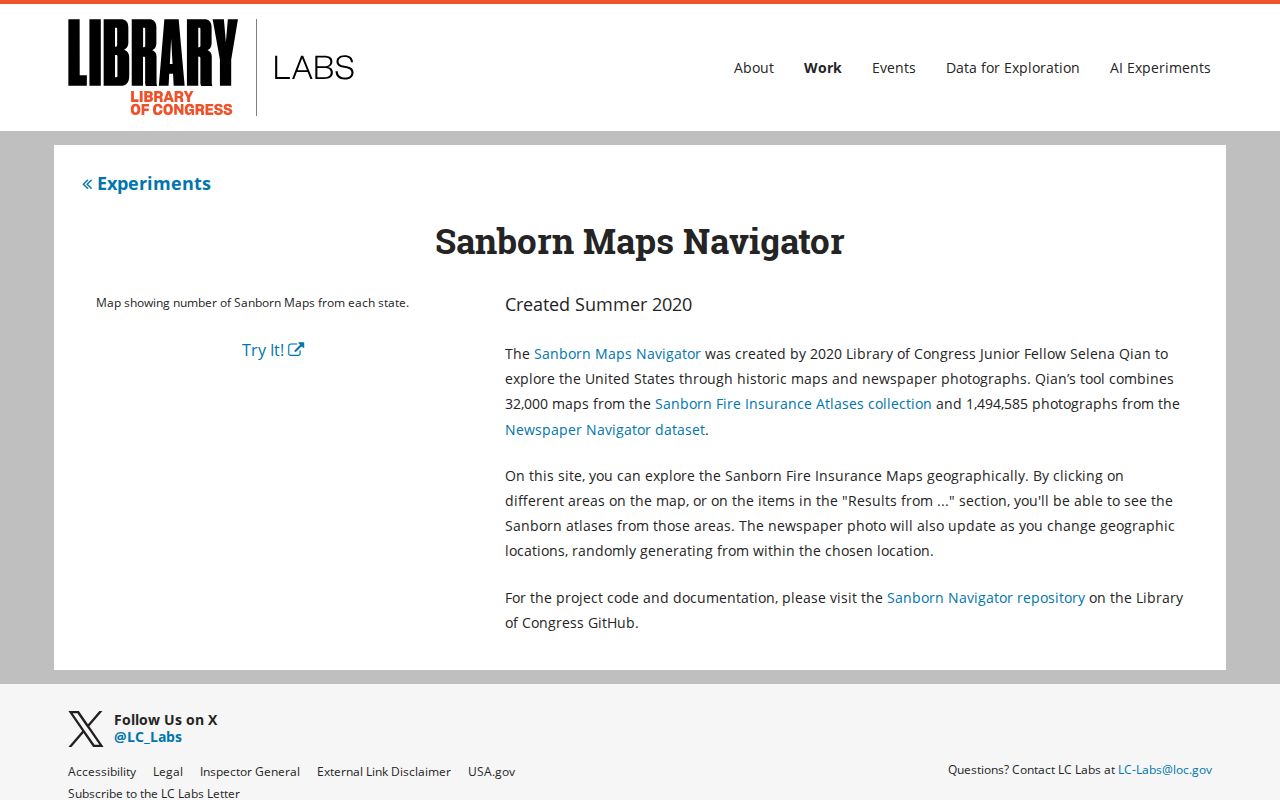
If a relevant sheet is later located, record the city or town heading, sheet number, year, scale, street labels, footprint, and building details, then reconcile it with the parcel rather than assuming the street number remained unchanged.
Note: No Marlboro-specific Sanborn year or sheet was verified in the reviewed official research sources during this review.
Marlboro Past Households and Obituaries
Past residents are best identified with a dated household source, not inferred from an owner field. The Marlboro library’s local-history collection includes yearbooks, maps, directories, photographs, church records, cemetery and Bible records, obituaries, and historical newspapers. The Monmouth County Historical Room and MCHA add county directories, local-history volumes, censuses, genealogy files, and on-site research resources.
MCHA lists obituary runs for the Monmouth Inquirer from July 1830 to 1888, Monmouth Democrat from July 1830 to December 1884, Freehold Transcript from September 1888 to 1919, and Red Bank Register from June 1878 to December 1988. Church and cemetery materials, probate, and vital records can test a relationship or death clue. An obituary remains secondary evidence and should be checked against the relevant primary record.
Lawful personal use. Marlboro house-history research suits family history, estate questions, local history, and personal curiosity. Do not use old or current records to track, harass, intimidate, or harm any living person.